
How to Disagree in English Without Sounding Rude (30 Phrases by Strength)
페이지 정보
 Michael Desrosiers
Langclub Co-founder · MA, Johns Hopkins University
Michael Desrosiers
Langclub Co-founder · MA, Johns Hopkins University

"I disagree" is not rude. It is blunt. The problem is not politeness, it is that those two words end the discussion instead of continuing it. Advanced speakers disagree constantly. They just signal exactly how strongly they mean it.
Below is a ladder of thirty phrases sorted by strength, the sentence structure that makes disagreement land well, and three mistakes that sound worse than saying nothing.
Contents
- Why "I disagree" fails
- The strength ladder: 30 phrases
- The structure that works
- The words doing the real work
- Three mistakes to avoid
- Changing register by situation
1. Why "I Disagree" Fails
It is grammatically perfect and it is what every textbook teaches. It still causes problems, for three reasons.
It gives no information. Do you mildly doubt this, or do you think it is completely wrong? A native speaker signals that distinction in the phrasing itself, before saying anything about the content. "I disagree" flattens the whole range into one setting.
It rejects the person, not the idea. Compare "I disagree" with "I am not sure that follows". The first is about you against them. The second is about the argument, and the other person can examine it without defending themselves.
It closes the turn. There is nothing to respond to except a repeat of the original claim. Skilled disagreement leaves an opening: a question, an alternative, a condition under which you would agree.
2. The Strength Ladder: 30 Phrases
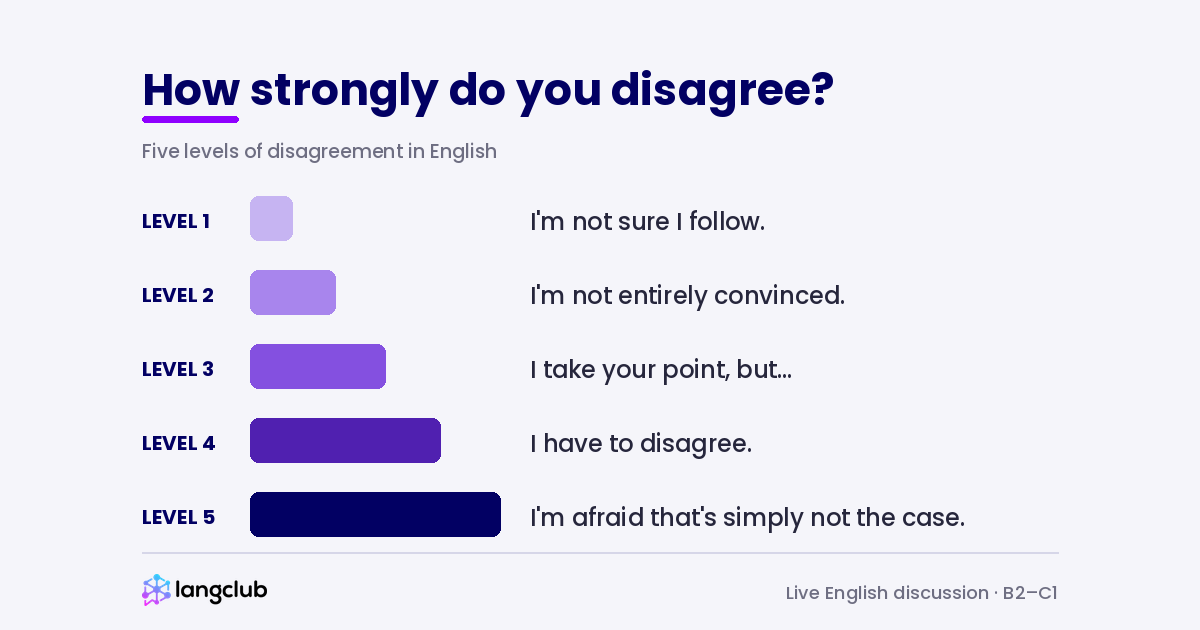
Level 1 is a gentle nudge. Level 5 is a flat refusal. Choose deliberately, because using level 4 language for a level 2 objection is the most common advanced-learner error in meetings.
| Level | Phrase |
|---|---|
| 1. Questioning You are not sure yet | I am not sure I follow. Could you say a bit more about that? What makes you say that? I had understood it slightly differently. Help me understand how you got there. I wonder if that holds in every case. |
| 2. Soft doubt You lean the other way | I am not entirely convinced. I see it slightly differently. That may be true, though I would put it differently. I tend to think the opposite, actually. I am not sure that follows. There may be another way of looking at this. |
| 3. Clear position You disagree and say so | I take your point, but I would argue that... I see where you are coming from, though I think... That is fair for X, but I do not think it extends to Y. I would push back on that slightly. I am going to disagree with you there. My reading of it is quite different. |
| 4. Firm You think they are wrong | I have to disagree. I do not think that is right. That is not what the evidence shows. I think that misses the point. I would strongly question that. That does not match my experience at all. |
| 5. Flat refusal Rare. Use with care. | I am afraid that is simply not the case. I cannot agree with that. That is not something I am able to accept. I think we will have to disagree on this. No, and here is why. That is factually incorrect. |
Most professional disagreement lives at levels 2 and 3. Level 1 is for when you genuinely might be wrong. Level 5 is for facts, ethics, and moments where agreement would be dishonest. Reaching for level 5 in an ordinary discussion does not make you sound confident, it makes you sound like you have run out of arguments.
3. The Structure That Works
Strong disagreement in English follows a three-part shape. Learners who know the phrases but not the shape still sound abrupt.
Acknowledge → Pivot → Propose
"That is a fair point about the cost (acknowledge), but I am not sure the timeline works (pivot). What if we split it into two phases? (propose)"
Acknowledge means naming the part that is genuinely right. Not "I understand your position", which is empty and everyone knows it. Something specific: the cost, the risk, the precedent.
Pivot is where the disagreement goes. Use but, though, or however. English listeners are trained to wait for this word, so once you have used it the acknowledgement is understood as setup and the real content follows.
Propose is the part most learners skip, and it does the most work. Disagreement without an alternative is criticism. Disagreement with an alternative is contribution. Even a question counts: "would it change anything if we assumed the opposite?"
The full shape is not always necessary. In casual conversation, acknowledge and pivot are enough. In a meeting where you are blocking a decision, all three are close to mandatory.
4. The Words Doing the Real Work
Politeness in English disagreement comes mostly from a small set of grammatical devices called hedges. They make a claim provisional, which invites a response rather than a defense.
- Modal verbs. "That would not work" is softer than "that does not work". Would, might, and could place the claim in a hypothetical space.
- Tentative verbs. "I tend to think", "I would suggest", "it seems to me". These frame your view as one reading among several.
- Quantity softeners. "I am not entirely sure", "that is slightly different", "I would push back a little". Entirely, slightly, and a little reduce the temperature without reducing the content.
- Question forms. "Is it possible that...", "would it be fair to say...". These hand the other person a route out.
- Past tense for present meaning. "I was going to say", "I had thought", "I wondered whether". Distancing in time creates distance in force, which is why it sounds gentler.
Notice that none of these change what you are claiming. They change how much room you leave the other person. That is the entire mechanism.
5. Three Mistakes to Avoid
Over-hedging. "I am sorry, I might be completely wrong here, and this is probably a stupid question, but I was just wondering if maybe..." By the time you arrive, nobody is listening, and you have told the room your point is not worth taking seriously. Two hedges maximum. One is usually better.
"With all due respect." This phrase does not mean what its words say. In practice it is heard as a warning that an insult is coming, and it is used that way in British and American English almost universally. It is one of the few phrases that will make a room tense. Avoid it entirely.
Agreeing when you do not agree. Nodding along and then acting differently damages trust far more than open disagreement. In most English-speaking professional cultures, someone who never disagrees is read as either disengaged or not senior enough to have a view. Silence is not neutral.
6. Changing Register by Situation
The same disagreement needs different clothing depending on where you are.
| Situation | How it sounds |
|---|---|
| Work meeting | Acknowledge first, always propose an alternative. Level 2 to 3. "That is a fair point, though I am not sure the timeline holds. Could we phase it?" |
| Academic seminar | Attack the argument, never the speaker. Ask for the evidence. Level 3 to 4 is normal and expected. "I am not sure that follows from the data you have shown." |
| Written email | Softer than speech, because tone is invisible and readers default to the harshest reading. Drop one level from what you would say aloud. |
| Casual conversation | Hedging can sound cold between friends. "Nah, I don't buy that" is warmer than "I am not entirely convinced." Formality creates distance. |
| Customer or client | Never level 4 or 5 directly. Reframe as a constraint rather than a disagreement. "What we can do is..." rather than "that is not possible." |
One cultural note. Directness norms vary sharply across English-speaking countries. Dutch and German speakers often find British disagreement evasive; British listeners often find direct disagreement aggressive. American professional English sits in between and tends to reward proposing an alternative. If you are unsure, match the level of the person you are speaking to and adjust from there.
How to Practice This
Reading a list of phrases will not put them in your mouth. Under pressure you will reach for whatever you have actually said before, which for most learners is "I disagree" or nothing at all.
Two things work.
Pick one level and use it for a week. Most learners have a comfortable band of two or three phrases and never leave it. Deliberately using level 3 language when you would normally hedge at level 1 is uncomfortable and it is exactly where the growth is.
Disagree about things that do not matter. This is what makes discussion practice valuable at advanced level. Arguing about whether money buys happiness, with someone you will never meet again, costs nothing and builds the reflex you will need in a meeting where it does cost something.
For questions worth arguing over, see our 50 advanced discussion topics, which are the prompts our sessions actually run on.
Practice Disagreeing With Real People
You cannot rehearse this alone. Disagreement is a two-person skill, and the part that is hard is not the phrase, it is holding your position while someone pushes back in real time.
Langclub runs live discussion sessions every day with B2 to C1 speakers from over 140 countries. Real debates, real disagreement, and no consequences for getting the level wrong while you are learning it.