
What Makes a Speaking Club Advanced? It Is Not the Level Filter
페이지 정보
 Michael Desrosiers
Langclub Co-founder · MA, Johns Hopkins University
Michael Desrosiers
Langclub Co-founder · MA, Johns Hopkins University
Most English speaking clubs will let you choose an advanced level. Very few of them are actually advanced. Those are different things, and the difference decides whether you spend an hour stretching your English or an hour answering questions you answered five years ago.
This page is about what separates one speaking club from another, and why the topics matter more than the level filter.
Contents
- A level filter is not a level
- The topic decides who shows up
- What to check before you join one
- How Langclub is built
1. A Level Filter Is Not a Level
Almost every speaking platform offers level matching. You select advanced, and the system puts you with other people who selected advanced. On paper this solves the problem.
In practice it usually does not, for a structural reason. Most people looking for online English conversation are beginners and intermediates. That is simply where the demand is. So a platform serving every level ends up with a participant pool weighted toward the lower end, and the culture of the place follows the majority.
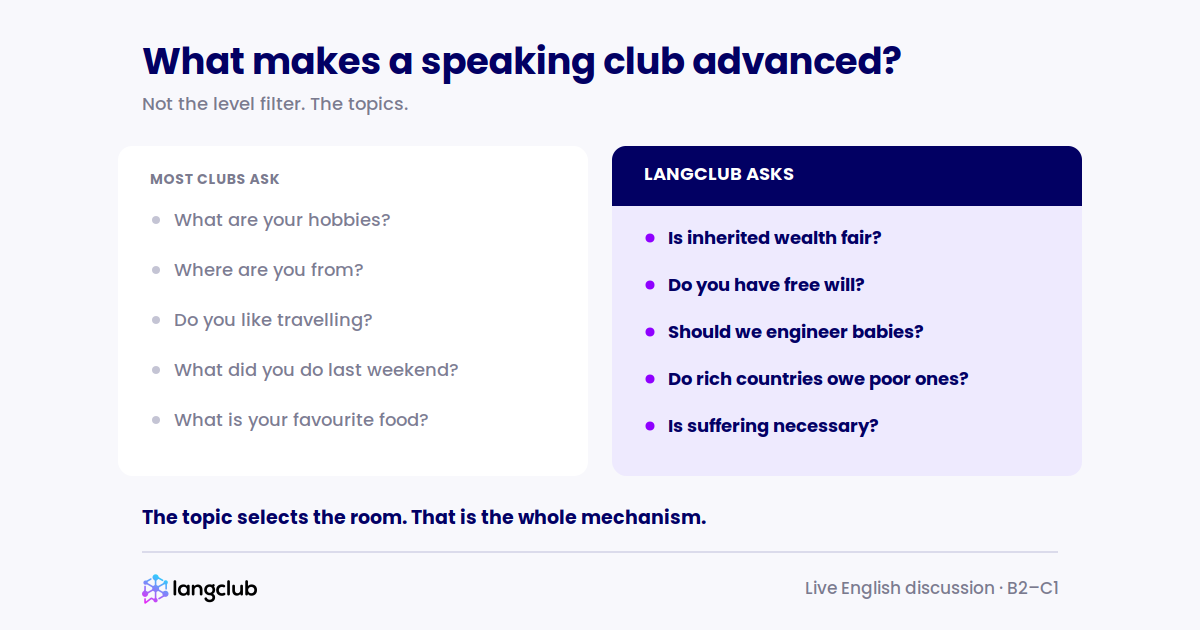
What that looks like in a session: you get matched with people who also ticked advanced, and the conversation still lands on hobbies, weekend plans, and where everyone is from. Nobody is doing anything wrong. It is just the default that the room settles into.
For a B2 or C1 speaker this matters more than it does at lower levels. Below B2, almost any speaking practice helps, because the bottleneck is fluency itself. Above B2, your progress depends on who is in the room. You need people who can explain a complicated position, push back on yours, and ask a follow-up that you have to think about. Without that, you get an hour of talking and no pressure on the parts of your English that have stopped improving.
2. The Topic Decides Who Shows Up
Here is the part most people miss. A club's level is not set by its level filter. It is set by what the club talks about.
If the standing topics are travel, food, hobbies, and weekend plans, the club will fill with people for whom those topics are the right difficulty. That is not a criticism of those topics, they are the correct starting point for anyone building basic fluency. But they select for a particular kind of participant, and once that participant is the majority the club cannot easily become something else.
If the standing topics are ethics, technology, inequality, culture, and questions with no settled answer, a different filter operates. Not because anyone is turned away, but because those topics are genuinely harder to talk about, and people who cannot yet hold a position in English tend not to come back.
The barrier is the point. A topic that is slightly too hard for a beginner is exactly what keeps the room useful for everyone above that line. It is a curation mechanism disguised as a content choice.
The loop runs like this: demanding topics attract upper-intermediate and advanced speakers, those speakers raise the quality of the conversation, and the quality of the conversation attracts more people at that level. Nothing about it requires a matching algorithm.
3. What to Check Before You Join One
Five questions will tell you more than any pricing page.
- What did they discuss last week? If you cannot find out, that is an answer. If the list is hobbies and travel, you know the level regardless of what the filter offers.
- Is there a host, and what do they do? An unmoderated room defaults to whoever is most confident talking for forty minutes. A host is not there to carry the conversation but to create the conditions for one: managing time, assigning breakout groups, and removing participants who ruin the room. Without that, session quality becomes a lottery decided by whoever turns up.
- Are the questions prepared or improvised? Improvised questions drift toward small talk under pressure. Prepared prompts hold the level.
- Where is everyone from? A room with one first language becomes a room where people help each other in that language. Spread matters more than native-speaker presence.
- Is it scheduled or on demand? On demand is convenient and produces thin sessions. Scheduled means people arrived intending to be there.
4. How Langclub Is Built
Since this is a Langclub blog, here is the same treatment applied to us.
The average participant is B2. Not because we filter applicants, but because of everything below. The topics do the work.
The topics are the product. Sessions run on prepared discussion questions covering society, culture, economics, technology, psychology, philosophy, the environment, and global issues. Not "what are your hobbies" but "should we allow parents to genetically engineer their children", "is inherited wealth fair", "do rich countries owe poor countries anything".
You can check this rather than take our word for it. Our 50 advanced discussion topics are the actual prompts our sessions run on. If those look like the conversations you want to be having, this is the right room. If they look exhausting, it honestly is not.
Topic Guides remove the preparation problem. Demanding topics create an obvious objection: do participants have to study before every session? No. Each session now comes with a Topic Guide, a one-minute background briefing plus key vocabulary, useful expressions, discussion questions, and optional further reading.
It is a launchpad, not homework. Someone who knows nothing about a subject can pick up the context and the English they will need to say what they think about it. The depth stays; the barrier to entry drops.
Hosts run the room, they do not fill it. A Langclub host manages the clock, splits the group, reviews the Topic Guide, and steps into the conversation when it needs it. They do not lead the discussion, because it is not theirs to lead. It belongs to the participants.
We used to show only the host's nationality. Sessions now also display their profession or field, so you can see in advance whether the person running a discussion actually knows the subject.
Every day, over 140 countries, in the browser. No app to install. Two sessions free, then a subscription from $9.99 a month on the annual plan for unlimited sessions.
The Difference Is the Default, Not the Feature
Other platforms have advanced options. The question is whether advanced is one setting among many or the thing the whole room is built around.
If most speaking clubs get you talking more, the aim here is different: to make you think harder, and say something worth hearing.