
Where to Actually Practice English Speaking Online (Free and Paid, Com…
페이지 정보
 Michael Desrosiers
Langclub Co-founder · MA, Johns Hopkins University
Michael Desrosiers
Langclub Co-founder · MA, Johns Hopkins University
Most comparison articles are written by one of the platforms being compared. This one is too, so here is the disclosure up front: Langclub is on this list. It is also not the right answer for a lot of people, and the sections below say when.
The honest summary is that there is no single best option. There are four different products pretending to be the same product, and picking wrong is why most learners quit after a month.
Contents
- Decide what you actually need first
- Paid one-to-one tutoring
- Language exchange apps
- Free group discussion
- The comparison table
- What most people should actually do
1. Decide What You Actually Need First
"I want to practise speaking" describes at least four different needs, and they are served by different things.
- Correction. You want someone to tell you what you got wrong. This needs a qualified teacher and it is not cheap.
- Volume. You know the grammar and you simply need hours of talking. This needs frequency more than quality, and paying professional rates for it is a waste of money.
- Exam preparation. You need someone who knows the IELTS or TOEFL rubric specifically. A friendly native speaker who has never seen the marking criteria cannot help you here.
- Confidence. You freeze up. What you need is low-stakes repetition until speaking stops feeling like a performance.
Most learners at B2 and above need volume and confidence, and buy correction instead. That is the expensive mistake this article is trying to prevent.
2. Paid One-to-One Tutoring
italki
A marketplace of individual teachers who set their own prices. Two tiers: Community Tutors, who are fluent speakers offering conversation practice, and Professional Teachers, who are certified and teach structured lessons. Community tutors commonly sit around four to fifteen dollars an hour; professional teachers run from roughly fifteen dollars upward.
Good for: targeted correction, exam preparation with a teacher who knows the rubric, and learners who want the same person tracking their progress over months.
Not good for: daily practice. At community tutor rates a thirty-minute session every day still lands around three hundred dollars a month, and professional teachers are far higher. Almost nobody sustains that.
Preply
Similar marketplace model, but built around a subscription with committed weekly hours rather than pay-as-you-go. English tutors typically fall between fifteen and twenty-five dollars an hour, with a wider range at both ends. There is no free trial, though discounted first lessons exist.
Good for: learners who need accountability. The weekly commitment is the feature, not a flaw, if your problem is that you keep skipping practice.
Not good for: unpredictable schedules. If work or travel regularly breaks your week, a subscription with fixed hours becomes money spent on lessons you did not take.
Cambly
Subscription with on-demand access to native English speakers. You open the app and start talking, without booking in advance. Sessions are recorded automatically. Roughly eight to seventeen dollars per thirty-minute session depending on plan.
Good for: people who cannot plan ahead and want to practise when the mood strikes. The instant access is genuinely useful and nothing else on this list matches it.
Not good for: structured improvement. Tutors are native speakers but not necessarily trained teachers, so quality varies. For daily use the subscription reaches a few hundred dollars a month.
3. Language Exchange Apps
HelloTalk and Tandem match you with a native English speaker who wants to learn your language. Free at the core, with paid tiers for extra features.
Good for: zero budget, and building a genuine relationship with one or two partners over time. When it works, it works very well.
Not good for: efficiency. Half of every conversation is you speaking English and half is your partner speaking your language, so an hour buys you thirty minutes. Matching is unreliable, a lot of conversations die after two messages, and both apps attract people looking for something other than language practice. Expect to spend real effort filtering before you find a good partner.
4. Free Group Discussion
Discord servers and Meetup groups host free English conversation. Quality varies enormously between communities and there is no standard to compare against. Some are excellent. Many are three people and long silences.
Good for: zero budget, and finding a community if you land in a good one.
Not good for: reliability. There is usually nobody moderating, no level matching, and no guarantee a session happens at all. Meetup groups are also mostly local, which rules them out if you are not in a large city.
Langclub
Since we are on this list, the same treatment applies.
Daily group discussion sessions with B2 to C1 speakers from over 140 countries. Moderated, scheduled in advance, and run in the browser with no app to install. Sessions are built around discussion prompts rather than lessons.
Two sessions are free. After that it is a subscription, from $9.99 a month on the annual plan, for unlimited sessions. That is roughly what a single hour with a community tutor costs elsewhere.
Good for: volume and confidence, which is what most advanced learners actually need. Speaking with people from many first-language backgrounds is also closer to how English is used professionally than speaking only with native speakers is.
Not good for: three things. It is a group format, so you get less individual talking time than a one-to-one lesson, and if your goal is to be corrected sentence by sentence, book a tutor instead. Sessions run at scheduled times rather than on demand, so it will not help you at two in the morning. And it is not free beyond the first two sessions, so if your budget is genuinely zero, the language exchange apps are the honest answer.
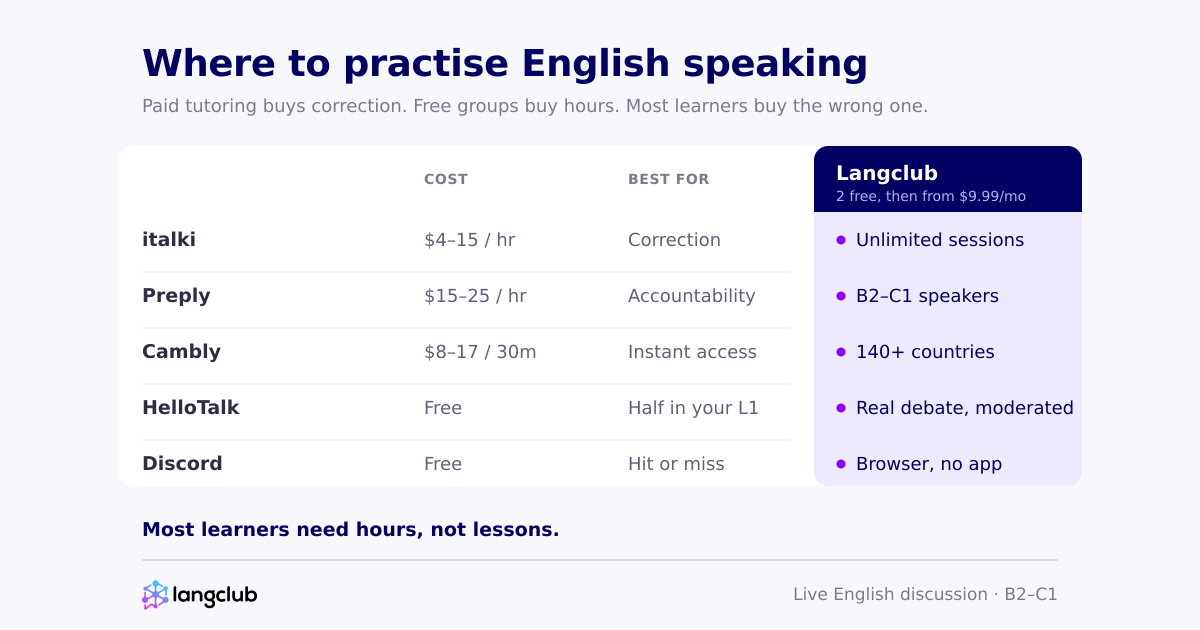
5. The Comparison Table
| Platform | Format | Typical cost | Best for |
|---|---|---|---|
| italki | 1-to-1, booked | $4–15/hr community $15+/hr professional | Correction, exam prep |
| Preply | 1-to-1, subscription | $15–25/hr typical | Accountability |
| Cambly | 1-to-1, on demand | $8–17 per 30 min | Instant access |
| HelloTalk / Tandem | 1-to-1 exchange | Free core | Zero budget, long-term partner |
| Discord / Meetup | Group, variable | Free | Community, if you find a good one |
| Langclub | Group, scheduled | 2 free, then from $9.99/mo | Unlimited sessions, B2–C1 discussion |
Prices are approximate and taken from public pricing pages in 2026. All of these platforms change their rates, so check before committing.
6. What Most People Should Actually Do
Stop looking for one platform. The learners who improve fastest use two, and they use them for different jobs.
Group discussion for volume. Three or four sessions a week at a flat monthly rate, not per lesson. This is where the hours come from, and hours are what turns knowledge into fluency.
One paid lesson a month for correction. A single professional teacher session, where you ask them to interrupt you and note every error. One hour of real correction is worth more than ten hours of polite conversation where nobody tells you anything.
That combination runs about twenty dollars a month instead of three hundred, and it covers both needs. The mistake is buying expensive one-to-one lessons and using them for casual conversation, which is paying professional rates for something you can get for free.
Try the Free Option First
Before spending anything, find out how much of your problem is simply lack of practice. Most B2 learners are surprised by how much improves in a month of consistent speaking, without a single paid lesson.
Langclub runs live discussion sessions every day with B2 to C1 speakers from over 140 countries. Your first two are free, in your browser, no app.