
Debate: Is Artificial Intelligence an Existential Threat
Learn topic-related expressions and join the speaking club to practice them!
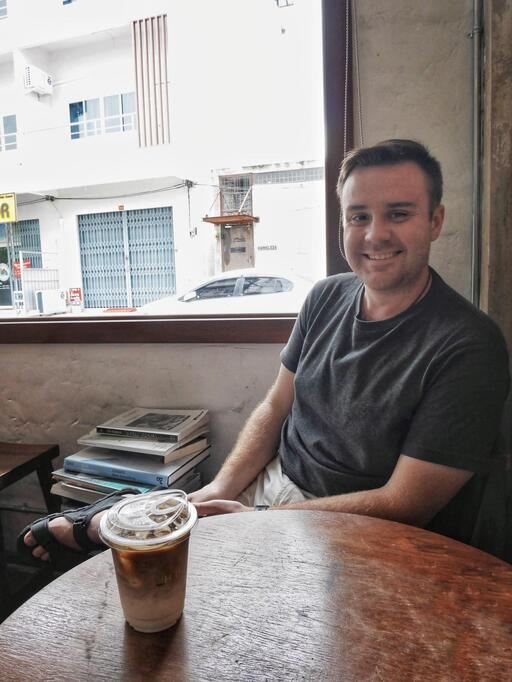

I'm Teacher Michael, a licensed English teacher.
I'm originally from the United States, but I have been working as a full-time TEFL-certified high school English teacher in Thailand since 2013. I have a Bachelor's Degree in International Relations and I am currently studying for my Master's Degree in Liberal Arts.

Topic guide Optional
A quick way to understand the topic and find useful language. Read as much or as little as you like.
1-minute overview
Artificial intelligence is already reshaping research, medicine, education, creative work, and security. Its strengths—speed, pattern recognition, and the ability to handle vast amounts of information—can help people make discoveries and improve services. Yet today’s systems can also produce convincing falsehoods, reproduce bias, expose personal data, and make fraud or manipulation easier. In healthcare, for example, AI may support diagnosis while raising difficult questions about accountability, consent, and unequal performance across patient groups.
The existential-threat debate concerns a more uncertain possibility: could increasingly capable, autonomous systems eventually escape meaningful human control or enable catastrophic misuse? Some people see this as a serious long-term risk requiring precaution now; others argue that immediate harms such as surveillance, job disruption, and concentrated corporate power deserve greater attention. The idea of a conscious singularity remains speculative: intelligence, autonomy, and subjective experience are not the same thing. A productive debate separates evidence from prediction and asks what proportionate governance, technical safeguards, and human oversight should look like.
The existential-threat debate concerns a more uncertain possibility: could increasingly capable, autonomous systems eventually escape meaningful human control or enable catastrophic misuse? Some people see this as a serious long-term risk requiring precaution now; others argue that immediate harms such as surveillance, job disruption, and concentrated corporate power deserve greater attention. The idea of a conscious singularity remains speculative: intelligence, autonomy, and subjective experience are not the same thing. A productive debate separates evidence from prediction and asks what proportionate governance, technical safeguards, and human oversight should look like.
Useful vocabulary
Approx. CEFR · Topic relevance
existential threat
A danger that could destroy humanity or permanently damage its future.
I see AI as a potential existential threat only if humans lose the ability to control it.
alignment
The extent to which an AI system’s goals and behavior match human values and intentions.
Better alignment may reduce the chance that an AI follows instructions in harmful ways.
autonomy
The ability to act or make decisions independently, with limited human direction.
The risk increases when an AI system has both high autonomy and access to important tools.
hallucination
A false or invented answer produced by an AI system that sounds convincing.
Doctors should not rely on an AI report without checking it for hallucinations.
algorithmic bias
A systematic unfairness in an AI system’s results, often linked to biased data or design choices.
Algorithmic bias could lead to some patient groups receiving less accurate medical advice.
data minimization
The principle of collecting and using only the personal data that is genuinely necessary.
Data minimization could protect privacy when AI is used in hospitals or schools.
Useful expressions
The crucial distinction is between ___ and ___.
Use this to separate related ideas that are often confused.
The crucial distinction is between an intelligent system and a conscious one.
That scenario is possible, but its probability remains unclear.
Use this to acknowledge a risk without overstating the evidence.
That scenario is possible, but its probability remains unclear.
We should weigh the severity of the harm against the likelihood of it occurring.
Use this to assess whether a response is proportionate.
We should weigh the severity of the harm against the likelihood of it occurring.
The benefits may be substantial, provided that certain safeguards are in place.
Use this to offer conditional support rather than unconditional approval.
The benefits may be substantial, provided that independent testing is in place.
I would challenge the assumption that ___ automatically leads to ___.
Use this to question a causal claim respectfully.
I would challenge the assumption that greater AI capability automatically leads to consciousness.
Question list
- Ice breaking
- Main topic
- Free talk
| Q1. | Where would you place your personal time capsule? |
|---|---|
| Q2. | If you could completely redesign your evenings, what would you include? |
| Q3. | Imagine spending an afternoon with your future self—what would you want to know? |
| Q4. | What’s the best way to learn a new language? |
| Q5. | How do you regain balance after a chaotic week? |
| Q6. | How do you hold yourself accountable for personal goals? |
| Q7. | What is your opinion on television? |
| Q8. | What’s a creative process that feels like a natural extension of yourself? |
| Q1. | Does artificial intelligence pose an existential threat? |
|---|---|
| Q2. | What are the biggest pros and cons of modern AI? |
| Q3. | Do you believe that there will be a "singularity event" in which AI will become conscious? |
| Q4. | Should we be worried about the rise of intelligent machines? |
| Q5. | What role should governments play in regulating AI development? |
| Q6. | What are the ethical implications of using AI in healthcare? |
| Q7. | How will artificial intelligence impact privacy rights? |
| Q8. | Is it morally wrong to create sentient artificial beings? |
| Q1. | How do you think the concept of "global citizenship" has evolved over time, and what role does it play in today's interconnected world? |
|---|---|
| Q2. | Describe a simple act of kindness you experienced that had a lasting effect on you. |
| Q3. | If you had to sum up your current life season in a single metaphor, what would it be? |
| Q4. | How does participating in group activities shape personal confidence? |
| Q5. | What's the craziest thing you've ever eaten? |
| Q6. | Markets filled with textiles and fabrics often feel like museums of color. Have you browsed through one? |
| Q7. | Are banks the best place to keep your money? |
| Q8. | What does the concept of belief mean to you? |
Rules


Please be kind and respectful.
Note: You can be banned for violating any of these rules
No flirting! Don't ask for other people's social network, number etc. if he/she refuses to give them.
Note: You can be banned for violating any of these rules
Give others an equal opportunity to speak.
Note: You can be banned for violating any of these rules
Avoid Smoking / Drinking while you are talking.
Note: You can be banned for violating any of these rules
Turning your camera on is mandatory.
Note: You can be banned for violating any of these rules
Ready to join the conversation?
Book your spot and bring your perspective to the discussion.