
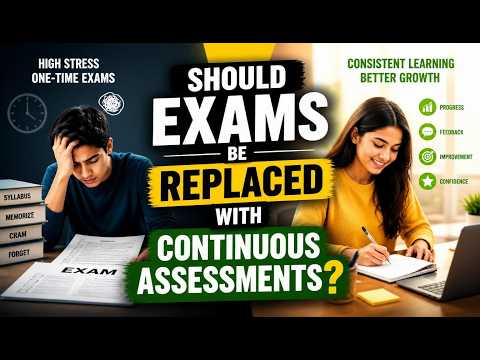
Debate: Should schools replace exams with project-based assessments?
Learn topic-related expressions and join the speaking club to practice them!


I'm Teacher Michael, a licensed English teacher.
I'm originally from the United States, but I have been working as a full-time TEFL-certified high school English teacher in Thailand since 2013. I have a Bachelor's Degree in International Relations and I am currently studying for my Master's Degree in Liberal Arts.

Topic guide Optional
A quick way to understand the topic and find useful language. Read as much or as little as you like.
1-minute overview
Exams are efficient: students work under the same conditions, results are easy to compare, and schools can assess large numbers of learners quickly. Supporters argue that well-designed tests reveal individual knowledge, reasoning, and the ability to perform under pressure. Critics respond that a short, timed test can reward memory, test-taking strategies, or confidence more than deep understanding.
Project-based assessment asks students to investigate a problem, create something, and explain their choices over a longer period. It may capture collaboration, creativity, research, and practical application, but it also raises concerns about unequal access to time, technology, tutoring, and quiet study space. The key issue may not be whether one method should completely replace the other, but what combination produces valid, fair evidence of learning. Teachers can strengthen projects through checkpoints, individual reflections, oral defenses, and clear assessment criteria. Finland is often said to have eliminated homework, but homework still exists there; it is generally less central than in many systems.
Project-based assessment asks students to investigate a problem, create something, and explain their choices over a longer period. It may capture collaboration, creativity, research, and practical application, but it also raises concerns about unequal access to time, technology, tutoring, and quiet study space. The key issue may not be whether one method should completely replace the other, but what combination produces valid, fair evidence of learning. Teachers can strengthen projects through checkpoints, individual reflections, oral defenses, and clear assessment criteria. Finland is often said to have eliminated homework, but homework still exists there; it is generally less central than in many systems.
Useful vocabulary
Approx. CEFR · Topic relevance
project-based assessment
Evaluation based on a sustained task that applies learning to a real or realistic problem.
A project-based assessment can show whether students can use knowledge rather than simply recall it.
standardization
The use of the same rules, tasks, or scoring methods for everyone.
Standardization makes exam results easier to compare across different classes.
authentic assessment
Assessment that reflects practical tasks or challenges outside the classroom.
Designing a community campaign may be a more authentic assessment than answering multiple-choice questions.
academic integrity
Honest and responsible conduct in academic work, including giving credit and avoiding cheating.
Regular progress checks can protect academic integrity in long-term projects.
moderation
A process in which teachers review marking to make grades consistent and fair.
Schools may use moderation when different teachers assess the same type of project.
socioeconomic advantage
Benefits linked to a student’s family income, education, or access to resources.
A project requiring expensive materials may unfairly reward socioeconomic advantage.
Useful expressions
The strongest case for this approach is that...
Use it to introduce the most persuasive argument in favor of an idea.
The strongest case for this approach is that it measures how students apply knowledge.
That conclusion depends on what we mean by...
Use it to question an unclear assumption or definition.
That conclusion depends on what we mean by educational success.
There is a trade-off between comparability and depth.
Use it to compare the benefits and limits of two assessment methods.
There is a trade-off between comparability and depth when schools rely heavily on exams.
This may be fair in principle, but uneven in practice.
Use it to distinguish an ideal policy from its real-world effects.
Group projects may be fair in principle, but uneven in practice when students have unequal support at home.
A mixed model would address some of these concerns.
Use it to propose a balanced alternative rather than an all-or-nothing choice.
A mixed model would address some of these concerns by combining exams, projects, and individual presentations.
Question list
- Ice breaking
- Main topic
- Free talk
| Q1. | What is your favorite quote and why? |
|---|---|
| Q2. | What hobbies did you used to have, but now do not? |
| Q3. | Where do you leave things you cherish most? |
| Q4. | If you could relive a moment where you chose courage, what moment was it? |
| Q5. | Do you prefer early mornings or late nights? |
| Q6. | How do you approach situations that challenge your patience or resilience? |
| Q7. | When you're sick, what are some things you eat/drink/watch/etc. to be comfortable? |
| Q8. | How do you celebrate your personal growth milestones, big or small? |
| Q1. | Do you think exams accurately measure how much a student has learned? |
|---|---|
| Q2. | What are the biggest advantages of project-based assessments compared with traditional exams? |
| Q3. | How would you describe your country's education system? |
| Q4. | Are project-based assessments fair if some students have more time, money, or help at home? |
| Q5. | How could teachers make sure that students do their own work on large projects? |
| Q6. | Do group projects accurately measure an individual student's abilities? |
| Q7. | Some countries, such as Finland, have completely eliminated homework. What is your opinion about this? |
| Q8. | What should be done to increase the standard of education globally? |
| Q1. | If you could choose a nickname for yourself, what would you want it to be and why? |
|---|---|
| Q2. | Which public health policy would improve access to preventive care? |
| Q3. | How do you manage expectations from people close to you? |
| Q4. | When do you feel most adventurous in your routine? |
| Q5. | What helps you ask thoughtful questions? |
| Q6. | What is your favorite type of volunteer work or community service? |
| Q7. | How do you think we can promote greater physical activity and fitness? |
| Q8. | How often do you exercise/play sports? |
Rules


Please be kind and respectful.
Note: You can be banned for violating any of these rules
No flirting! Don't ask for other people's social network, number etc. if he/she refuses to give them.
Note: You can be banned for violating any of these rules
Give others an equal opportunity to speak.
Note: You can be banned for violating any of these rules
Avoid Smoking / Drinking while you are talking.
Note: You can be banned for violating any of these rules
Turning your camera on is mandatory.
Note: You can be banned for violating any of these rules
Ready to join the conversation?
Book your spot and bring your perspective to the discussion.