
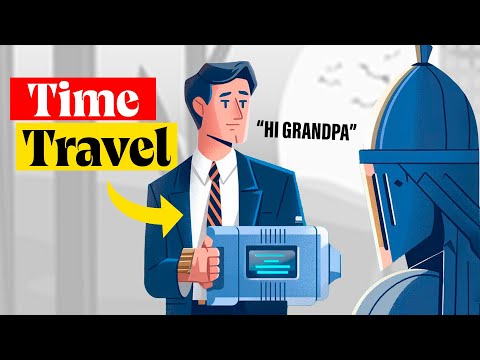
If you could travel in time, would you prefer to visit the past or future?
Learn topic-related expressions and join the speaking club to practice them!

I am a certified TEFL instructor and native English teacher with hands-on experience delivering English due to my experience abroad in Hong Kong. I specialize in creating inclusive, judgment-free classrooms that adapt to diverse learners, including SEN students, using CLT and task-based methods, and I am currently pursuing IELTS certification to further strengthen my qualifications. I enjoy connecting with students from all backgrounds and am committed to helping them build confidence and skills through engaging, supportive instruction.
 2 Gold Tickets
Topic guide Optional
A quick way to understand the topic and find useful language. Read as much or as little as you like.
1-minute overview
Time travel is a powerful thought experiment because it combines personal imagination with difficult questions about science, history, and responsibility. Modern physics shows that time can pass at different rates for observers moving extremely fast or experiencing different gravitational conditions, so limited travel into the future is not purely fictional. Travel to the past, however, remains speculative and raises major problems about cause and effect.
Choosing between the past and the future reveals different values. The past may offer answers to historical mysteries, a chance to meet ancestors, or an opportunity to prevent suffering. Yet changing one event could produce unintended consequences, erase people’s lives, or create a paradox. The future might show us solutions to today’s global problems, but it could also expose us to information we are not ready to handle. These scenarios invite a deeper question: if events can be altered or were always destined to occur, how free are our choices?
Choosing between the past and the future reveals different values. The past may offer answers to historical mysteries, a chance to meet ancestors, or an opportunity to prevent suffering. Yet changing one event could produce unintended consequences, erase people’s lives, or create a paradox. The future might show us solutions to today’s global problems, but it could also expose us to information we are not ready to handle. These scenarios invite a deeper question: if events can be altered or were always destined to occur, how free are our choices?
Useful vocabulary
Approx. CEFR · Topic relevance
causality
/kɔˈzæləti/the relationship in which one event directly produces another
Changing one small event in the past could disrupt causality in ways we cannot predict.
time dilation
the difference in the passage of time between observers in different physical conditions
Time dilation suggests that travelling far into the future may be more scientifically plausible than travelling into the past.
paradox
/ˈpærədɑks/a situation that seems logically impossible or self-contradictory
The classic paradox is going back in time and preventing your own time-travel journey.
unintended consequences
results that were not planned or expected
Even a well-intentioned attempt to prevent a disaster might have unintended consequences.
determinism
/dɪˈtɜrməˌnɪzəm/the idea that all events, including human actions, are fixed by earlier causes
If determinism is true, time travel might reveal that our choices were never fully open.
historical record
the evidence and accounts through which we understand the past
A visitor from the future could correct gaps or biases in the historical record.
Useful expressions
That depends on whether we assume a single timeline or multiple timelines.
Use this to clarify the rules behind a time-travel scenario.
That depends on whether we assume a single timeline or multiple timelines; the ethical consequences would be very different.
The strongest argument in favor of that view is that...
Use this to introduce your best supporting reason.
The strongest argument in favor of visiting the future is that it could help us prepare for long-term threats.
We should distinguish between knowing the future and being able to change it.
Use this to separate two ideas that are often treated as identical.
We should distinguish between knowing the future and being able to change it, because information does not automatically create control.
That solution may create a bigger problem than the one it solves.
Use this to challenge an apparently simple intervention.
Stopping one conflict might save lives, but that solution may create a bigger problem than the one it solves.
From an ethical standpoint, the key issue is who bears the risk.
Use this to focus on fairness and responsibility.
From an ethical standpoint, the key issue is who bears the risk when a traveler changes the lives of people in the past.
Question list
- Ice breaking
- Main topic
- Free talk
| Q1. | Where would you choose to spend a peaceful evening? |
|---|---|
| Q2. | Why are you learning English? |
| Q3. | What’s a hobby that brings you unexpected joy? |
| Q4. | Have you ever fallen asleep while talking to someone? |
| Q5. | What advice would you ask from someone older? |
| Q6. | Where do you observe small changes that matter? |
| Q7. | Describe an everyday task that feels meditative or soothing to you. |
| Q8. | What are your thoughts on cheating in exams? |
| Q1. | If you could travel in time, would you prefer to visit the past or future? |
|---|---|
| Q2. | What would be the risks or dangers of time travel? |
| Q3. | Would it be ethical to change the past to prevent a disaster? |
| Q4. | What historical mystery would you like to solve through time travel? |
| Q5. | If you could relive any day in your life, which day would it be and why? |
| Q6. | How would you use time travel to solve a current world problem? |
| Q7. | Can time travel give us a better understanding of free will? |
| Q8. | How do you imagine society to look 100 years from now? 1000 years? |
| Q1. | Describe a childhood dream you still think about sometimes. |
|---|---|
| Q2. | How do you approach a task you’ve never done before? |
| Q3. | How do you think we can improve healthcare accessibility and affordability? |
| Q4. | How do you think the concept of "global citizenship" has evolved over time, and what role does it play in today's interconnected world? |
| Q5. | What is your definition of 'happiness'? |
| Q6. | How do you keep conversations meaningful with long-time friends? |
| Q7. | Who was your first Native English-speaking teacher? |
| Q8. | Which fictional character would make the worst roommate and why? |
Rules


Please be kind and respectful.
Note: You can be banned for violating any of these rules
No flirting! Don't ask for other people's social network, number etc. if he/she refuses to give them.
Note: You can be banned for violating any of these rules
Give others an equal opportunity to speak.
Note: You can be banned for violating any of these rules
Avoid Smoking / Drinking while you are talking.
Note: You can be banned for violating any of these rules
Turning your camera on is mandatory.
Note: You can be banned for violating any of these rules
Ready to join the conversation?
Book your spot and bring your perspective to the discussion.