
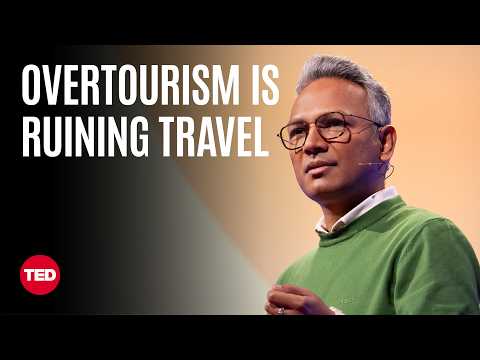
Is overtourism ruining travel?
Learn topic-related expressions and join the speaking club to practice them!
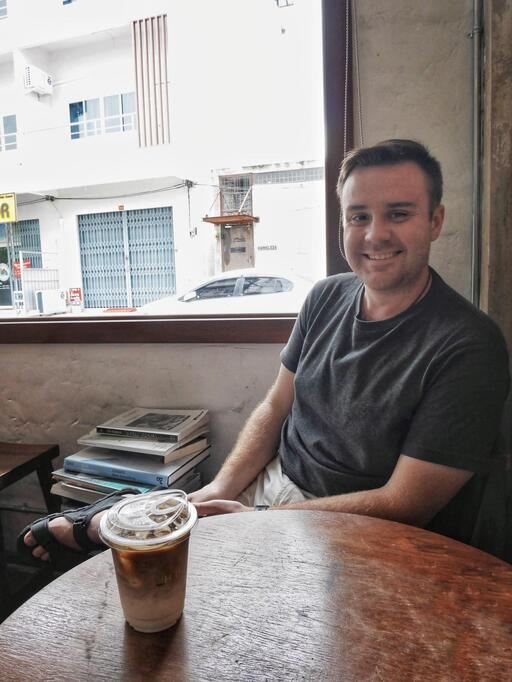

I'm Teacher Michael, a licensed English teacher.
I'm originally from the United States, but I have been working as a full-time TEFL-certified high school English teacher in Thailand since 2013. I have a Bachelor's Degree in International Relations and I am currently studying for my Master's Degree in Liberal Arts.
 2 Gold Tickets
Topic guide Optional
A quick way to understand the topic and find useful language. Read as much or as little as you like.
1-minute overview
Overtourism occurs when visitor numbers or behaviour put excessive pressure on a destination, reducing local quality of life, damaging natural or cultural sites, or making the experience worse for visitors themselves. It is not simply a matter of a place being popular: timing, infrastructure, housing, transport and the way tourism income is shared all matter. Recent tourism growth has intensified the debate, especially where large numbers of visitors concentrate in a few neighbourhoods or during a short high season.
Tourism can create jobs, support small businesses and encourage cultural exchange. At the same time, residents may face crowded public spaces, higher rents, noise and services designed mainly for visitors. Social media adds another tension: it can introduce people to remarkable places and local businesses, but viral images may turn fragile locations into photo stops. Possible responses include timed entry, visitor caps, higher fees, better public transport and encouraging travel outside peak periods. The difficult question is who should decide what a destination can reasonably absorb—and whether restrictions protect communities or make travel a privilege for wealthier people.
Tourism can create jobs, support small businesses and encourage cultural exchange. At the same time, residents may face crowded public spaces, higher rents, noise and services designed mainly for visitors. Social media adds another tension: it can introduce people to remarkable places and local businesses, but viral images may turn fragile locations into photo stops. Possible responses include timed entry, visitor caps, higher fees, better public transport and encouraging travel outside peak periods. The difficult question is who should decide what a destination can reasonably absorb—and whether restrictions protect communities or make travel a privilege for wealthier people.
Useful vocabulary
Approx. CEFR · Topic relevance
overtourism
/ˌoʊvərˈtʊrɪzəm/Tourism that causes serious harm or disruption to a destination and its residents.
Overtourism is not just about crowds; it is about whether a community can live well with tourism.
carrying capacity
The maximum level of visitors a place can handle without unacceptable damage or disruption.
A small island may reach its carrying capacity long before a large city does.
visitor cap
An official limit on the number of people allowed to enter or visit a place.
A visitor cap could protect the site, but it might also exclude spontaneous travellers.
gentrification
/ˌdʒentrəfɪˈkeɪʃən/A process in which an area becomes more expensive, often pushing out long-term residents.
Some residents argue that short-term rentals are accelerating gentrification in the old town.
peak season
The busiest period of the year for travel to a destination.
I would rather visit in the off-season than compete with crowds in peak season.
authenticity
/ˌɔθenˈtɪsəti/The quality of being genuine rather than designed mainly for tourists or appearances.
A place can still feel authentic even if it is popular, provided local life remains visible.
Useful expressions
The central trade-off is between … and …
Use this to identify two values that may conflict.
The central trade-off is between open access for travellers and protection for residents.
That argument assumes that …
Use this to reveal an unstated idea behind a claim.
That argument assumes that every extra tourist benefits the local community.
It depends less on the number of visitors than on …
Use this to shift attention from a simple explanation to a deeper factor.
It depends less on the number of visitors than on where they stay and how they behave.
We should distinguish between … and …
Use this to separate related ideas that are often confused.
We should distinguish between a crowded landmark and a city that is genuinely overwhelmed by tourism.
The burden is distributed unevenly.
Use this to point out that costs and benefits do not affect everyone equally.
Tourism revenue may be widespread, but the burden is distributed unevenly across neighbourhoods.
Question list
- Ice breaking
- Main topic
- Free talk
| Q1. | If you could feel grateful for one overlooked thing today, what would it be? |
|---|---|
| Q2. | What are your views on the concept of ego? |
| Q3. | Who is your role model, and why? |
| Q4. | What would you do differently if you could start your career over? |
| Q5. | What sight fills you with hope? |
| Q6. | What do you usually eat after working out? |
| Q7. | Are you a person who says something as it is or gives hints to it without saying? |
| Q8. | Where would you take someone to share a meaningful talk? |
| Q1. | Is overtourism ruining travel? |
|---|---|
| Q2. | Have you ever visited a place that was very disappointing to you? |
| Q3. | How does tourism affect your city or country? |
| Q4. | Has a bad travel experience ever changed your opinion of a country or city? |
| Q5. | What tourist attraction do you think is worth it or would like to visit the most? |
| Q6. | Should tourists pay higher prices than local residents at popular attractions? |
| Q7. | Do you believe that social media has made travel less authentic? |
| Q8. | What makes a travel experience memorable? |
| Q1. | Why does letting go of small worries often feel surprisingly difficult? |
|---|---|
| Q2. | What is your favorite type of dessert? |
| Q3. | What kind of atmosphere brings out the best in you? |
| Q4. | Why do big decisions feel easier after rest? |
| Q5. | What is the relationship between mind and reality? |
| Q6. | Do you prefer to spend time alone or with others? |
| Q7. | What makes bonding moments memorable? |
| Q8. | How often do you go shopping for groceries? |
Rules


Please be kind and respectful.
Note: You can be banned for violating any of these rules
No flirting! Don't ask for other people's social network, number etc. if he/she refuses to give them.
Note: You can be banned for violating any of these rules
Give others an equal opportunity to speak.
Note: You can be banned for violating any of these rules
Avoid Smoking / Drinking while you are talking.
Note: You can be banned for violating any of these rules
Turning your camera on is mandatory.
Note: You can be banned for violating any of these rules
Ready to join the conversation?
Book your spot and bring your perspective to the discussion.