
Should Deep-Sea Mining Be Allowed?
Learn topic-related expressions and join the speaking club to practice them!

Marhaban everyone! my name is Bilel and I'm from Tunisia . I have a bachelor's degree in English (International Relations). I have worked as a translator, International Business Developer and a director in a teaching center. After COVID, I started my carrier as a part-time English teacher in Tunis, the capital city of Tunisia. I'm an ambitious person, and never give up my dream of working for the Ministry of Foreign Affairs of Tunisia, and why not be an ambassador someday!?
I'm thrilled to see you all in the Langclub sessions.

Topic guide Optional
A quick way to understand the topic and find useful language. Read as much or as little as you like.
1-minute overview
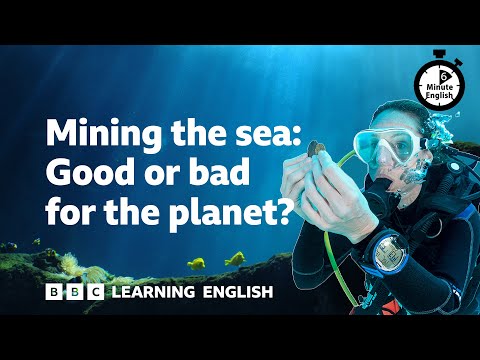
Deep-sea mining refers to extracting mineral deposits from the ocean floor, often several kilometres below the surface. Companies are especially interested in polymetallic nodules, sulphide deposits, and cobalt-rich crusts, which can contain nickel, copper, cobalt, manganese, and other metals used in batteries, electronics, and energy infrastructure. Supporters argue that these materials could diversify supply chains and help meet demand for a lower-carbon economy.
The central problem is uncertainty. Deep-ocean habitats are still poorly understood, yet mining could remove seafloor life, create sediment plumes, and introduce noise and light into ecosystems that may recover extremely slowly. No commercial mining in international waters has yet been approved, while rules are still being negotiated through the International Seabed Authority. This raises difficult questions about precaution, fairness, and global governance: should potentially shared benefits justify environmental risks, or should mining wait until science and safeguards are much stronger? Recycling, product redesign, and more responsible land-based mining may also reduce the pressure to open a new industrial frontier.
The central problem is uncertainty. Deep-ocean habitats are still poorly understood, yet mining could remove seafloor life, create sediment plumes, and introduce noise and light into ecosystems that may recover extremely slowly. No commercial mining in international waters has yet been approved, while rules are still being negotiated through the International Seabed Authority. This raises difficult questions about precaution, fairness, and global governance: should potentially shared benefits justify environmental risks, or should mining wait until science and safeguards are much stronger? Recycling, product redesign, and more responsible land-based mining may also reduce the pressure to open a new industrial frontier.
Useful vocabulary
Approx. CEFR · Topic relevance
polymetallic nodules
Rock-like lumps on the deep seafloor that contain several useful metals.
Polymetallic nodules are attractive because one deposit can contain nickel, copper, cobalt, and manganese.
critical minerals
Materials considered important for technology, industry, or energy systems and vulnerable to supply disruption.
Some argue that critical minerals should be sourced more responsibly, wherever they are found.
sediment plume
A cloud of fine particles stirred up in water by drilling, digging, or discharge.
A sediment plume could spread beyond the mining site and affect animals that filter food from water.
biodiversity
The variety of living species, genes, and ecosystems in an area.
The lack of data on deep-sea biodiversity makes the possible damage hard to predict.
precautionary principle
The idea that serious possible harm justifies preventive action even without complete scientific certainty.
A temporary ban would apply the precautionary principle to an ecosystem we barely understand.
common heritage of humankind
A legal and ethical concept that certain shared resources should benefit all people, not only powerful states or companies.
If the deep seabed is a common heritage of humankind, poorer countries should share in any benefits.
Useful expressions
The key trade-off is between … and …
Use it to identify two values or outcomes that may conflict.
The key trade-off is between securing mineral supplies and protecting fragile ecosystems.
That argument depends on the assumption that …
Use it to examine an unstated belief behind a claim.
That argument depends on the assumption that deep-sea metals cannot be obtained through recycling.
The burden of proof should lie with …
Use it to discuss who must demonstrate that an action is safe or justified.
The burden of proof should lie with companies that want to mine in such a poorly understood environment.
It is difficult to separate the short-term gains from the long-term consequences.
Use it to challenge narrow economic reasoning.
It is difficult to separate the short-term gains from the long-term consequences for ocean life.
A stricter framework would help, but it would not necessarily solve …
Use it to qualify support for regulation.
A stricter framework would help, but it would not necessarily solve the problem of limited scientific knowledge.
Sources & further reading
Question list
- Ice breaking
- Main topic
- Free talk
| Q1. | Have you reconciled with an old friend? Would you want to? |
|---|---|
| Q2. | When you were a kid, were you excited to be a grownup? What about growing up excited you? |
| Q3. | How do you think food can bring people together and foster connections across different cultures and backgrounds? |
| Q4. | What does a perfect day with the family look like? |
| Q5. | How do you show responsibility in your daily choices? |
| Q6. | How do you balance your personal and professional goals, and how do they influence one another? |
| Q7. | What do you wear when you're feeling your very best, and why? |
| Q8. | How do you recognize when a conversation becomes meaningful? |
| Q1. | What valuable materials can be found on the deep-sea floor? |
|---|---|
| Q2. | Why are companies interested in deep-sea mining? |
| Q3. | How could mining harm ocean ecosystems? |
| Q4. | Can society obtain these minerals in less damaging ways? |
| Q5. | Should economic benefits outweigh uncertain environmental risks? |
| Q6. | Who should control resources in international waters? |
| Q7. | Would strict regulation make deep-sea mining acceptable? |
| Q8. | Should there be a temporary global ban while scientists study the risks? |
| Q1. | What are you currently worrying about, if anything? |
|---|---|
| Q2. | How is your life going so far? |
| Q3. | What is your favorite holiday and why? |
| Q4. | How can workplaces promote greater diversity and inclusion? |
| Q5. | Do you believe in “right person, wrong time”? |
| Q6. | What's something you always wanted to do as a child but never got to do it? |
| Q7. | Would you rather be deeply respected or widely liked? Why? |
| Q8. | Why do we remember how someone made us feel more than what they said? |
Rules


Please be kind and respectful.
Note: You can be banned for violating any of these rules
No flirting! Don't ask for other people's social network, number etc. if he/she refuses to give them.
Note: You can be banned for violating any of these rules
Give others an equal opportunity to speak.
Note: You can be banned for violating any of these rules
Avoid Smoking / Drinking while you are talking.
Note: You can be banned for violating any of these rules
Turning your camera on is mandatory.
Note: You can be banned for violating any of these rules
Ready to join the conversation?
Book your spot and bring your perspective to the discussion.