
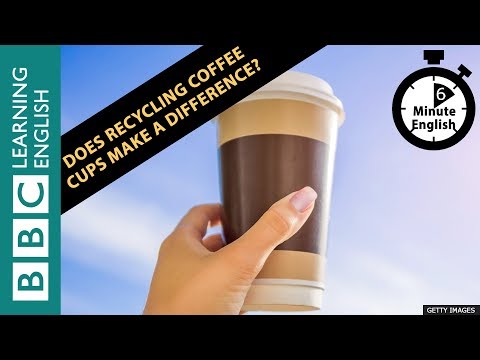
Should Disposable Coffee Cups Cost More?
Learn topic-related expressions and join the speaking club to practice them!


Hello World! My name is Sultan, and I'm a traveler in the world of information.
I'm a person who will work and invest all of my efforts in the progress of humanity as long as I am alive. So let's create a place where we can grow together, learn, experiment, and open something new that can help us improve not only our English skills but also our lives, and level up every day!
(It may sound crazy, but I like crazy things) ^_*

Topic guide Optional
A quick way to understand the topic and find useful language. Read as much or as little as you like.
1-minute overview
Disposable coffee cups make takeaway drinks convenient, but their low visible price can hide environmental and financial costs. Many cups combine paper with plastic or other linings, which can make recycling difficult depending on local collection systems. A small charge could encourage people to pause and consider whether they really need a single-use cup, while also helping cafés cover waste-management costs.
However, a charge is not automatically fair or effective. People who commute unpredictably, have disabilities, lack access to washing facilities, or simply forget a reusable cup may experience it as an inconvenience rather than a useful incentive. Research and policy trials often suggest that direct charges can change behavior more strongly than equivalent discounts, but good design matters. The discussion is really about responsibility: should individuals change daily habits, should businesses redesign their service, or should cities create better reuse and recycling systems?
However, a charge is not automatically fair or effective. People who commute unpredictably, have disabilities, lack access to washing facilities, or simply forget a reusable cup may experience it as an inconvenience rather than a useful incentive. Research and policy trials often suggest that direct charges can change behavior more strongly than equivalent discounts, but good design matters. The discussion is really about responsibility: should individuals change daily habits, should businesses redesign their service, or should cities create better reuse and recycling systems?
Useful vocabulary
Approx. CEFR · Topic relevance
single-use
Designed to be used once and then thrown away.
A single-use cup may be convenient, but its environmental cost continues after the coffee is gone.
surcharge
An extra amount added to the usual price.
A 25-cent surcharge could make customers think twice about taking a disposable cup.
incentive
Something that encourages a person to act in a particular way.
A meaningful incentive might persuade regular customers to carry reusable cups.
waste stream
The route by which discarded materials are collected, sorted, and processed.
If cups enter the wrong waste stream, they may not be recycled even when they look recyclable.
convenience culture
A way of life that prioritizes speed and ease, often through disposable products.
Disposable cups are part of a wider convenience culture, not an isolated problem.
disproportionate
Too large or unfair in relation to something else.
The fee could have a disproportionate effect on people who buy drinks while travelling for work.
Useful expressions
The key trade-off is between convenience and long-term cost.
Use it to identify the central tension in a policy choice.
The key trade-off is between convenience and long-term cost, both environmental and financial.
That depends on how the policy is designed.
Use it to avoid treating a broad proposal as one fixed idea.
That depends on how the policy is designed: a charge could be paired with accessible alternatives.
A price signal may work differently from a reward.
Use it to compare charges with discounts.
A price signal may work differently from a reward because people often notice an extra fee more strongly.
We should distinguish intention from outcome.
Use it to question whether a well-meant policy actually works.
We should distinguish intention from outcome; a recycling label does not guarantee that a cup will be recycled.
The burden should not fall on consumers alone.
Use it to argue for shared responsibility.
The burden should not fall on consumers alone if cafés and local authorities can improve reuse systems.
Question list
- Ice breaking
- Main topic
- Free talk
| Q1. | If you could spend an entire day exploring a single idea, what idea would you choose? |
|---|---|
| Q2. | If you could change one thing about your country's political system, what would it be? |
| Q3. | How do you differentiate between fear and intuition? |
| Q4. | If you could spend a day with any celebrity, who would it be and what would you do together? |
| Q5. | What is your favorite game ever? |
| Q6. | How do you challenge yourself to think differently? |
| Q7. | Is there a simple activity that instantly makes you feel centered and calm? |
| Q8. | Have you ever created something that exceeded even your own expectations? |
| Q1. | How often do you use disposable cups? |
|---|---|
| Q2. | Would a small extra charge make you bring a reusable cup? |
| Q3. | Should customers pay more for products that create unnecessary waste? |
| Q4. | Are discounts for reusable cups better than penalties for disposable ones? |
| Q5. | Should coffee shops be responsible for collecting and recycling their cups? |
| Q6. | Can small environmental charges actually change people's habits? |
| Q7. | Would such policies unfairly inconvenience some customers? |
| Q8. | What everyday disposable product would you most like to reduce? |
| Q1. | Why do people remember the first time they felt truly understood? |
|---|---|
| Q2. | Describe your favorite sound and why it’s meaningful to you. |
| Q3. | What is your opinion on the use of alternative medicine? |
| Q4. | How can schools help students maintain a healthy work-life balance? |
| Q5. | Technology often promises convenience. Do you think we’ve become too reliant on it? |
| Q6. | Do you think men tend to love themselves more than woman? |
| Q7. | What helps you make fair judgments about others? |
| Q8. | What’s something you wish schools taught more effectively? |
Rules


Please be kind and respectful.
Note: You can be banned for violating any of these rules
No flirting! Don't ask for other people's social network, number etc. if he/she refuses to give them.
Note: You can be banned for violating any of these rules
Give others an equal opportunity to speak.
Note: You can be banned for violating any of these rules
Avoid Smoking / Drinking while you are talking.
Note: You can be banned for violating any of these rules
Turning your camera on is mandatory.
Note: You can be banned for violating any of these rules
Ready to join the conversation?
Book your spot and bring your perspective to the discussion.