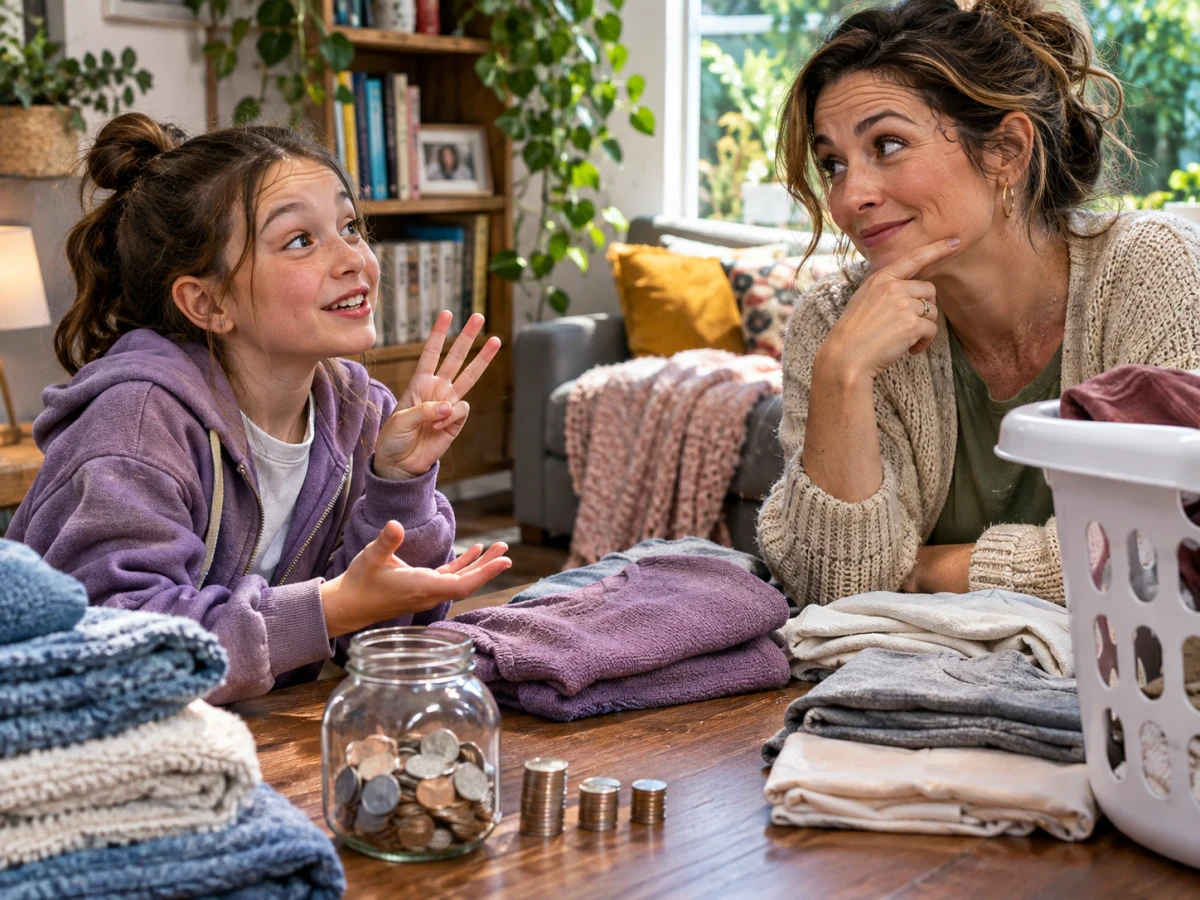
Should Parents Pay Children for Doing Chores?
Learn topic-related expressions and join the speaking club to practice them!


Marhaban everyone! my name is Bilel and I'm from Tunisia . I have a bachelor's degree in English (International Relations). I have worked as a translator, International Business Developer and a director in a teaching center. After COVID, I started my carrier as a part-time English teacher in Tunis, the capital city of Tunisia. I'm an ambitious person, and never give up my dream of working for the Ministry of Foreign Affairs of Tunisia, and why not be an ambassador someday!?
I'm thrilled to see you all in the Langclub sessions.

Topic guide Optional
A quick way to understand the topic and find useful language. Read as much or as little as you like.
1-minute overview
Few family decisions seem as small, yet reveal as much about values, as whether children should be paid for chores. One survey of American parents found that about two thirds give an allowance, though the amounts and the link to housework vary widely, and such figures should be treated cautiously.
Supporters argue that payment teaches budgeting, effort and the link between work and income. It can also give children early practice in saving and choosing. Critics respond that household tasks are part of belonging to a family, not a job. Some psychologists warn that external rewards can weaken intrinsic motivation, so a child may help only when there is something to gain.
The debate is also practical. Families must decide which duties are unpaid, whether harder jobs deserve more, and how to treat siblings of different ages fairly. Rewards need not be financial: praise, privileges or shared time may matter as much. Cultural expectations and household income shape every answer.
Useful vocabulary
Approx. CEFR · Topic relevance
allowance
A regular sum of money given to a child, sometimes linked to chores and sometimes not.
In our house the allowance was unconditional, so chores were never negotiated.
intrinsic motivation
The drive to do something because it is satisfying or meaningful in itself, not for an external reward.
Paying for every small task might weaken a child's intrinsic motivation to help.
incentive
/ɪnˈsɛntɪv/Something that encourages a person to act in a particular way.
Money can be a useful incentive, but it may crowd out kindness.
entitlement
/ɪnˈtaɪtlmənt/The belief that one deserves privileges or rewards without earning them.
Some parents fear that a generous allowance creates a sense of entitlement.
reciprocity
/ˌrɛsɪˈprɑːsəti/A mutual exchange in which people give and receive support in return.
A family can teach reciprocity by expecting everyone to contribute to shared life.
delegate
/ˈdɛlɪɡeɪt/To give a task or responsibility to someone else.
Parents who delegate chores fairly may avoid resentment between siblings.
Useful expressions
It depends on whether...
Qualifying a general claim by naming the condition that changes the answer.
It depends on whether the money is a reward or simply a teaching tool.
That may hold true for..., but not for...
Limiting an argument to certain people or situations.
That may hold true for teenagers, but not for young children who want to help.
On the one hand..., on the other...
Comparing two competing considerations in a balanced way.
On the one hand, pay teaches responsibility; on the other, it may reduce goodwill.
I'd push back on the idea that...
Politely challenging an assumption.
I'd push back on the idea that unpaid chores are always unfair.
What is at stake here is...
Identifying the deeper issue beneath a debate.
What is at stake here is how children understand family responsibility.
Question list
- Ice breaking
- Main topic
- Free talk
| Q1. | Which season is your favourite? |
|---|---|
| Q2. | How do you think social media has affected the way we communicate and form connections? |
| Q3. | What object sparks your creativity? |
| Q4. | What English word do you find hard to pronounce? |
| Q5. | What is your favorite way to spend a lazy day? |
| Q6. | How do you stay brave while trying something unfamiliar? |
| Q7. | What moment restored your confidence? |
| Q8. | When is the appropriate age to get married? |
| Q1. | Which chores did you do as a child? |
|---|---|
| Q2. | What might children learn by being paid for chores? |
| Q3. | Which tasks should everyone in a family share? |
| Q4. | Should harder chores earn more money? |
| Q5. | How could payment change a child’s attitude toward helping? |
| Q6. | Would you pay for chores done without being asked? |
| Q7. | What rewards could work besides money? |
| Q8. | How would you set a fair rule for siblings? |
| Q1. | Why do people often miss the signs of their own growth? |
|---|---|
| Q2. | What’s your favourite place to go shopping? |
| Q3. | What helps you regain motivation after failure? |
| Q4. | If you could just wear one color everyday for the rest of your life, what color would you pick? |
| Q5. | What makes you feel confident in group discussions? |
| Q6. | What makes cooperation smooth and effective? |
| Q7. | What’s a moment from the past week that made you smile? |
| Q8. | What experience recently taught you empathy? |
Rules


Please be kind and respectful.
Note: You can be banned for violating any of these rules
No flirting! Don't ask for other people's social network, number etc. if he/she refuses to give them.
Note: You can be banned for violating any of these rules
Give others an equal opportunity to speak.
Note: You can be banned for violating any of these rules
Avoid Smoking / Drinking while you are talking.
Note: You can be banned for violating any of these rules
Turning your camera on is mandatory.
Note: You can be banned for violating any of these rules
Ready to join the conversation?
Book your spot and bring your perspective to the discussion.