
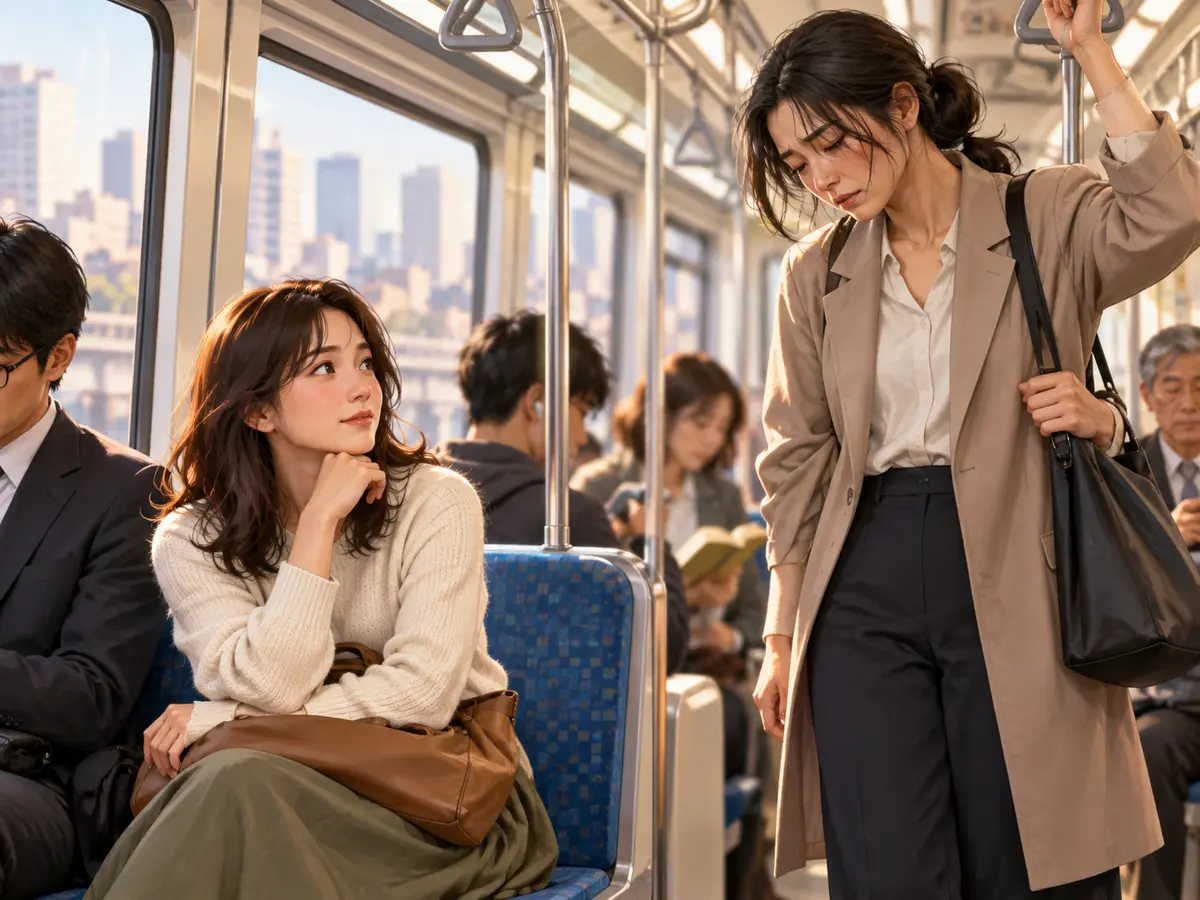
Should You Give Up Your Seat to Someone Who Looks Tired?
Learn topic-related expressions and join the speaking club to practice them!
Albert, an engineer and explorer.
Hello everyone! My name is Albert and I am super happy to meet each person here! I love communicating in English and therefore I try to practice it as much as I can. I am an engineer by my background, and I like to know how everything works, as well as I like travelling, music, all sorts of activities and adventures.

Topic guide Optional
A quick way to understand the topic and find useful language. Read as much or as little as you like.
1-minute overview
Offering a seat on public transport seems like a small act of kindness, yet it involves quick judgments about need, privacy, and fairness. Age, pregnancy, injury, a stroller, or visible difficulty balancing may make the choice seem obvious. But fatigue, chronic pain, dizziness, anxiety, and many disabilities are invisible. Someone who appears healthy may need to sit just as much as the person they are considering helping.
This makes the manner of an offer important. A quiet, non-assumptive question such as “Would you like to sit here?” can be considerate, while insisting or demanding an explanation can feel intrusive. Priority seats add another tension: they improve access for people who need them, but they are often empty when demand is low. The broader issue is how to share limited space respectfully without turning strangers’ bodies, health, or personal circumstances into public evidence. There may be no perfect rule, but everyday choices can reveal how a community understands care and dignity.
This makes the manner of an offer important. A quiet, non-assumptive question such as “Would you like to sit here?” can be considerate, while insisting or demanding an explanation can feel intrusive. Priority seats add another tension: they improve access for people who need them, but they are often empty when demand is low. The broader issue is how to share limited space respectfully without turning strangers’ bodies, health, or personal circumstances into public evidence. There may be no perfect rule, but everyday choices can reveal how a community understands care and dignity.
Useful vocabulary
Approx. CEFR · Topic relevance
priority seating
Seats intended first for passengers who may have greater difficulty standing.
I think priority seating should be available immediately when someone needs it.
invisible disability
A disability or health condition that is not obvious from someone’s appearance.
We should remember that an invisible disability can make standing painful or unsafe.
assumption
/əˈsʌmpʃən/A belief made without enough evidence.
Offering a seat is kind, but it can be based on an inaccurate assumption.
non-assumptive
/ˌnɑn əˈsʌmptɪv/Careful not to presume something about another person.
A non-assumptive offer gives the other person an easy choice.
mobility
The ability to move around safely and easily.
Crowded buses can be difficult for people with limited mobility.
intrusive
/ɪnˈtrusɪv/Involving unwanted attention to someone’s private life or body.
Asking why someone needs a seat may feel intrusive.
Useful expressions
The difficulty lies in distinguishing between courtesy and assumption.
Use this to identify the central tension in a social situation.
The difficulty lies in distinguishing between courtesy and assumption when we offer a stranger a seat.
Appearance is an imperfect guide to need.
Use this to challenge judgments based only on what is visible.
Appearance is an imperfect guide to need, especially on a crowded train.
A respectful default might be to offer rather than to presume.
Use this to propose a balanced practical approach.
A respectful default might be to offer rather than to presume that someone cannot stand.
The intention may be kind, but the impact can vary.
Use this to separate a person’s motive from another person’s experience.
The intention may be kind, but the impact can vary if the offer draws public attention.
It is less about ranking people’s needs than responding to the situation.
Use this to reject overly rigid rules about who deserves help most.
It is less about ranking people’s needs than responding to the situation with flexibility.
Question list
- Ice breaking
- Main topic
- Free talk
| Q1. | What is the biggest risk you have ever taken, and how did it turn out? |
|---|---|
| Q2. | Where do you go to reconnect with yourself? |
| Q3. | What is something on your bucket list? |
| Q4. | What's your favorite season? |
| Q5. | What topics of conversation do you enjoy most? |
| Q6. | What's your favorite emoji? |
| Q7. | Do you like to exercise? If so, what is your favorite type of exercise? |
| Q8. | What’s something you’ve created or accomplished that once seemed impossible? |
| Q1. | Have you ever offered your seat to a stranger? |
|---|---|
| Q2. | How can you tell when someone needs a seat? |
| Q3. | Would you offer a seat to someone who looks very tired? |
| Q4. | Could an offer sometimes embarrass the other person? |
| Q5. | Should priority seats be kept empty until needed? |
| Q6. | What would you do if someone refused your offer? |
| Q7. | Are people less willing to offer seats on crowded transport? |
| Q8. | Who should get a seat first when several people need one? |
| Q1. | What are your thoughts on climate change? |
|---|---|
| Q2. | What is the most memorable or impactful speech or presentation you've ever heard? |
| Q3. | How do you maintain fairness when you have personal biases? |
| Q4. | What makes you appreciate someone’s patience? |
| Q5. | What's your biggest regret in life? |
| Q6. | How do you stay focused and productive when faced with distractions? |
| Q7. | What are your thoughts on the impact of social media on interpersonal relationships? |
| Q8. | How do you keep relationships strong during busy periods? |
Rules


Please be kind and respectful.
Note: You can be banned for violating any of these rules
No flirting! Don't ask for other people's social network, number etc. if he/she refuses to give them.
Note: You can be banned for violating any of these rules
Give others an equal opportunity to speak.
Note: You can be banned for violating any of these rules
Avoid Smoking / Drinking while you are talking.
Note: You can be banned for violating any of these rules
Turning your camera on is mandatory.
Note: You can be banned for violating any of these rules
Ready to join the conversation?
Book your spot and bring your perspective to the discussion.