
What Would Life Be Like with a Personal Robot?
Learn topic-related expressions and join the speaking club to practice them!


I’m Ken, a Kenyan accountant with a special love for languages. I enjoy cross-cultural conversations and love hearing different accents from around the world come together through one shared language. I especially enjoy easy, judgment-free conversations where there is no pressure for perfection—just people connecting over random topics.

Topic guide Optional
A quick way to understand the topic and find useful language. Read as much or as little as you like.
1-minute overview
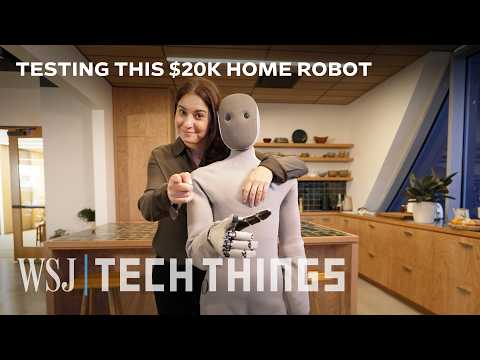
Personal robots have moved beyond vacuum cleaners and voice assistants toward machines designed to navigate homes, handle objects, and assist with routine chores. The video features 1X’s humanoid NEO, illustrating both the appeal and the awkwardness of this idea. A robot that loads a dishwasher, carries laundry, or fetches items could save time and support people with limited mobility. Yet home environments are unpredictable: pets, children, stairs, fragile objects, and changing routines make reliable autonomy extremely difficult.
The bigger questions may be social rather than technical. A domestic robot could extend independence for older adults or disabled people, but it might also reduce everyday exercise, skills, or human contact. Cameras, microphones, cloud services, and occasional remote assistance raise questions about surveillance, consent, and cybersecurity. People may form emotional bonds with an apparently helpful machine, even if it does not understand them. Ultimately, whether a personal robot feels liberating or intrusive may depend on its price, reliability, limits, and the degree of human control.
The bigger questions may be social rather than technical. A domestic robot could extend independence for older adults or disabled people, but it might also reduce everyday exercise, skills, or human contact. Cameras, microphones, cloud services, and occasional remote assistance raise questions about surveillance, consent, and cybersecurity. People may form emotional bonds with an apparently helpful machine, even if it does not understand them. Ultimately, whether a personal robot feels liberating or intrusive may depend on its price, reliability, limits, and the degree of human control.
Useful vocabulary
Approx. CEFR · Topic relevance
autonomy
/ɔːˈtɑːnəmi/The ability to operate and make decisions without direct human control.
I would trust a home robot only if it had enough autonomy to handle simple problems safely.
teleoperation
/ˌtɛliˌɑpəˈreɪʃən/The remote control of a robot by a human operator.
Teleoperation may be useful at first, but I would not want a stranger to see inside my home.
domestic robot
A robot designed to do tasks in a private home.
A domestic robot should be judged by how well it fits into ordinary family life, not just by impressive demonstrations.
surveillance
/sərˈveɪləns/Close monitoring of people, often using cameras, sensors, or data.
The convenience of a robot could come at the cost of constant surveillance.
assistive technology
Technology that helps people perform tasks or live more independently.
For many older people, assistive technology could be more valuable than a robot that simply saves time.
emotional attachment
A strong feeling of affection or connection toward someone or something.
Emotional attachment to a robot may be understandable, especially for people who live alone.
Useful expressions
The key trade-off is between convenience and control.
Use this to introduce a central tension in the topic.
The key trade-off is between convenience and control: the robot can help more if it collects more data.
That benefit comes with an important caveat.
Use this to qualify a positive claim.
A robot could reduce loneliness for some people, but that benefit comes with an important caveat: it cannot offer genuine human care.
It depends on where we draw the line.
Use this when acceptable limits vary from person to person.
Should a robot help someone bathe or manage medication? It depends on where we draw the line.
We should distinguish between assistance and replacement.
Use this to compare supportive technology with technology that takes over a human role.
We should distinguish between assistance and replacement when discussing robots in elder care.
The real test is how it performs in everyday conditions.
Use this to challenge claims based on ideal demonstrations.
A robot may look impressive in a showroom, but the real test is how it performs in everyday conditions.
Sources & further reading
Question list
- Ice breaking
- Main topic
- Free talk
| Q1. | Which part of your life feels the most vibrant and alive right now? |
|---|---|
| Q2. | What fictional object would be useful in real life? |
| Q3. | If you were told you inspire others already, how would that change your day? |
| Q4. | What habit reflects your true priorities? |
| Q5. | Describe a moment when you felt truly in sync with a group of people. |
| Q6. | Have you ever locked yourself out of the house? |
| Q7. | If you could have any type of vehicle, what would it be and why? |
| Q8. | How do you stay calm when facing unpredictable situations? |
| Q1. | Which daily task would you give to a personal robot first? |
|---|---|
| Q2. | Would you trust a robot to stay alone in your home? |
| Q3. | How could personal robots help older people? |
| Q4. | Which jobs should a home robot never do? |
| Q5. | Would a robot make people more independent or more lazy? |
| Q6. | How much privacy would you give up for greater convenience? |
| Q7. | Could people become emotionally attached to their robots? |
| Q8. | What price would make a personal robot worth buying? |
| Q1. | What societal changes are fueling the rise of online activism? |
|---|---|
| Q2. | Why do we feel deeply connected to certain stories or characters? |
| Q3. | How do you think the concept of "slow food" and a focus on quality and tradition can enhance our overall relationship with food? |
| Q4. | Cultural festivals of light often hold deep meaning. Have you witnessed such a celebration? |
| Q5. | Folklore can preserve unique cultural values. Which tale from your background fascinates you most? |
| Q6. | What is something you think you should do more often? |
| Q7. | Why does discovering a new interest feel like opening a door? |
| Q8. | Should people be allowed to genetically modify their children? |
Rules


Please be kind and respectful.
Note: You can be banned for violating any of these rules
No flirting! Don't ask for other people's social network, number etc. if he/she refuses to give them.
Note: You can be banned for violating any of these rules
Give others an equal opportunity to speak.
Note: You can be banned for violating any of these rules
Avoid Smoking / Drinking while you are talking.
Note: You can be banned for violating any of these rules
Turning your camera on is mandatory.
Note: You can be banned for violating any of these rules
Ready to join the conversation?
Book your spot and bring your perspective to the discussion.