
What to Say When You Don't Understand Someone in English (25 Phrases b…
페이지 정보
 Michael Desrosiers
Langclub Co-founder · MA, Johns Hopkins University
Michael Desrosiers
Langclub Co-founder · MA, Johns Hopkins University
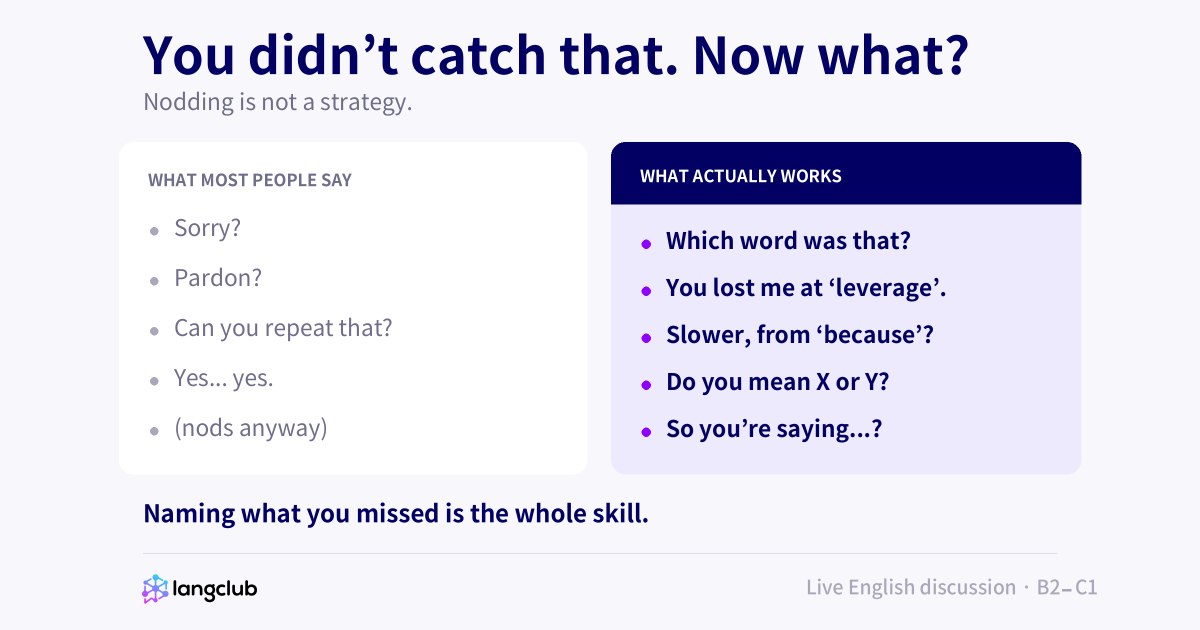
The moment you stop understanding is not the problem. What you do in the next two seconds is. Most people do the same thing: they say "sorry?", get the identical sentence back at the identical speed, and then nod as if that fixed it.
It did not fix it. And by the third "sorry?" most people give up and start nodding at things they have not understood, which is how you end up in an hour of English conversation having understood about half of it.
This page is a set of phrases for that exact moment, sorted by what actually went wrong. Because "sorry?" is not one situation, it is six.
Contents
- Why "sorry?" stops working the third time
- The skill is naming what you missed
- The 25 phrases, by situation
- Three things to stop saying
- Where to practise this
1. Why "Sorry?" Stops Working the Third Time
"Sorry?" is a request for a repeat. That is all the information it carries. The other person now knows that something went wrong, but not what, so they do the only reasonable thing available to them: they say the same sentence again.
Sometimes slightly louder. Volume was rarely the problem.
If what you actually missed was one unfamiliar word in the middle, you have just heard the whole sentence a second time and you are still missing that one word. If the sentence was too fast, it comes back at roughly the same speed, because people cannot easily judge their own pace. If you heard every word but could not work out what the person meant, a repeat gives you nothing at all.
There is a social cost too. Three identical "sorry?"s in a row start to feel like an interruption, so people stop asking well before they stop being lost. That is the real damage. Not the misunderstanding itself, but the silence that follows it, where you are still in the conversation but no longer really in it.
Native speakers do this constantly, by the way. They just do it so quickly that it does not register as repair: "wait, whose brother?", "the what?", "sorry, from where?". Short, specific, and back into the conversation in under a second. It is not a politeness ritual. It is a targeting system.
2. The Skill Is Naming What You Missed
Before you can ask a good question you need about half a second of diagnosis. In practice there are six failures, and they need six different repairs.
- One word. You followed the sentence and hit a word you do not know.
- The whole thing. You were not attending, or the accent knocked you sideways at the first syllable.
- Speed. You caught individual words but not fast enough to assemble them before the next ones arrived.
- Meaning. You heard every word, they were all words you know, and the sentence still does not resolve into anything.
- Uncertainty. You think you understood, and the cost of being wrong is high enough that you want to check.
- The pattern. It keeps happening with this person, and repairing each instance separately is not working.
Almost everyone treats all six as the same event and reaches for the same phrase. Sorting them costs you nothing and changes the answer you get back.
Two notes before the list. First, name the last thing you did understand — "you lost me after the tax part" is far more useful than "I did not understand". It tells the other person exactly where to restart, and it proves you were following until then. Second, ask immediately. A question two sentences later requires the person to reconstruct what they were saying, and by then the group has moved on.
3. The 25 Phrases, by Situation
You missed one word
The most common failure and the easiest to fix, as long as you point at the word instead of the sentence. Repeat the word back if you caught its shape at all, even if you mangle it — that is usually enough for the other person to identify it.
- "Sorry, what was that word — leverage?"
- "You lost me at leverage."
- "What does leverage mean here?"
- "One word — leverage? I do not know that one."
You missed the whole sentence
No shame in this one, and it is worth saying plainly rather than pretending you got most of it. Being explicit that you missed all of it stops the other person from repeating just the last three words.
- "Sorry, I did not catch any of that."
- "Could you say that again? I missed it completely."
- "I lost the whole thing — one more time?"
- "Can you start that again from the beginning?"
It was too fast
Say the word "slower". People genuinely cannot hear their own speed, and "sorry?" will not surface it. Naming a restart point is even better, because it turns a full repeat into a short one.
- "Could you slow down a little? I am still catching up."
- "That was a bit fast for me — again, slower?"
- "Same thing, half the speed?"
- "Sorry, from because onwards — slower?"
If you want to know why fast English collapses into noise even when you know every word in it, that is a mechanical problem with a mechanical explanation, and we wrote about it separately in why you cannot understand native speakers at full speed.
You heard it, but the meaning did not land
This is the one where a repeat is actively useless, and where most people nod instead of asking. You need a different sentence, not the same one.
- "I heard you, but I am not sure what you mean."
- "Sorry, I do not follow."
- "Can you put that another way?"
- "Can you give me an example?"
"Can you give me an example" is the strongest item on this entire list. It works when you cannot even articulate what confused you, it never sounds like a language problem, and a concrete example resolves an abstract sentence far more reliably than a rephrasing does.
You need to check you understood
Use these when you think you have it and want to confirm before building on it. They also do something the others do not: they keep the conversation moving forwards, because you are contributing a version of the idea rather than only asking for a repeat.
- "So you are saying...?"
- "Do you mean X, or Y?"
- "Let me check I have got this — you are saying...?"
- "Is that the same as saying...?"
- "If I understood right, ..."
The X-or-Y version is worth singling out. Offering two specific readings gives the other person something to choose between, which is much easier to answer than an open question, and it demonstrates that you were following closely enough to construct both. In a group discussion this reads as engagement rather than as a gap.
You need to change how they speak, permanently
When it keeps happening with the same person, stop repairing instance by instance and reset the terms once, at the start. Ten seconds here saves the whole hour.
- "I am following, just a bit slower than usual — feel free to repeat things."
- "If I look lost, just check with me."
- "I will stop you if I lose the thread, is that all right?"
- "Quick thing before we start — I might ask you to repeat sometimes."
These are disarming in a way the others are not, because they are said before anything has gone wrong. You are not apologising for a failure, you are setting up how the conversation will run.
4. Three Things to Stop Saying
"Sorry, my English is bad." It is not an explanation and it does not help the other person adjust. It also reframes a normal conversational repair as a personal deficiency, which changes how the rest of the conversation goes. Everyone asks people to repeat things, in every language they speak.
"Sorry" three times in a row. The first one is a repair, the third is an apology for existing. Use one, then switch to naming the problem. "You lost me at the tax part" contains no apology and works better than all three.
Nothing at all. The nod is the expensive option. It saves you two seconds of discomfort and costs you the rest of the topic, because every sentence after the one you missed is built on it. If you take one thing from this page, it is that asking is cheaper than it feels, and the cost of not asking compounds.
5. Where to Practise This
Here is the awkward part. You cannot practise clarification alone, and this is the one area where studying does not transfer. You can memorise all 25 phrases this afternoon and still freeze in a real conversation, because the hard part was never the wording. It is doing it in real time, at a moment when you feel behind and would rather not draw attention to yourself.
That reflex only changes by being used. Which means you need a room with actual people in it, talking about something demanding enough that you will genuinely lose the thread sometimes.
That is what Langclub sessions are. Small group discussions in the browser, every day, across more than 140 countries, running on prepared topics rather than small talk — questions like these, on society, ethics, technology, and economics. Demanding topics are the point: they are where you will need these phrases, and where using them is completely normal because everyone in the room is stretching.
Each session comes with a Topic Guide, a short background briefing with key vocabulary and expressions, so an unfamiliar subject does not become an unfamiliar subject and an unfamiliar word list. A host runs the clock and steps in when the conversation needs it, but does not lead it — the discussion belongs to the participants.
Two sessions are free, no app to install. If you want the companion skill to this one, disagreeing with someone without accidentally sounding blunt, that is 30 phrases sorted by strength.
The Two Seconds Are the Whole Thing
Everyone loses the thread in a second language. The difference between people who keep improving and people who plateau is not how often it happens. It is whether the next move is a precise question or a nod.
You now have the questions. What is missing is a room to use them in.